Showing posts with label electrical engineering. Show all posts

Wednesday, March 25, 2015

Making Big Things With LittleBits


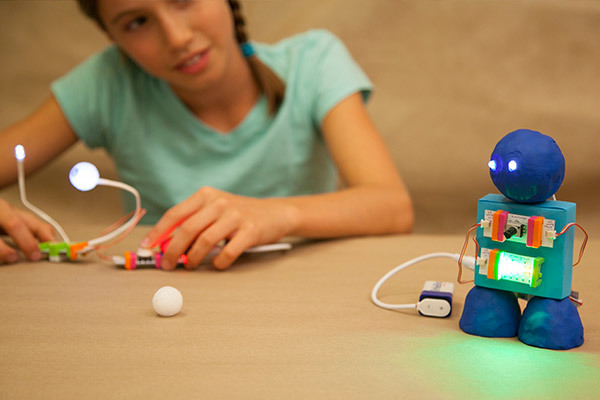
What is LittleBits?

Learning electronics isn't an easy task. To beginners, the  jumble of wires, soldering, and different electrical components can easily scare them away. LittleBits simplifies the complexity of the hardware into electronic modules that snap together with magnets. Learning electronics then becomes as easy as putting together Lego pieces. The only limit now? Your imagination.


An introduction to LittleBits from their website


There's an ever-growing library of electronic modules for you to use. The LittleBits website features a variety of starter kits to match the projects YOU want to work on. For example, there's a synth kit for all the musicians out there, a space kit for all the future astronauts, and finally the cheapest option is the base kit where you can learn the basics of electronics and get the basic modules for your module library.

LittleBits in Action

If you aren't sold yet, here are some examples of the awesome things you can make with the LittleBits kits.

With just the BaseKit


An Art Bot:


You can even check out projects and tutorials made by fellow LittleBit users at the MakerHub!

Vijay Dhruv's FerrisWheel:


Yoo-Bin Lee's LittleLine Follower


Thursday, October 30, 2014

How do you build a circuit?


A basic component of electrical engineering is a circuit. A circuit is simply a loop that has a current running through it. The current helps the circuit do whatever it was designed to do, like send information from one source to another or power an object, like a LED light. So, how do you build a circuit?

It's actually pretty simple. All you need is a power source and connections. See, most power sources, like a battery, have two terminals: a positive one and a negative one. Current is created when there is a path from one terminal to the other. This path can be created using wires. Whatever is put in the circuit will also get the current, helping it do whatever it needs to do.


Most of the times, engineers like to test out their circuits before they finish them. This is when a breadboard is used. The breadboard has holes on the top so that you can use wires to connect the things in your circuit together. Each column of the breadboard has a wire underneath it to make checking your circuit easier. You make your circuit on the breadboard and check to see if it works right! 

Once you're sure your circuit does what you want it to, you finish it by fixing it to a circuit board. A circuit board is made out of copper and is printed with your wire connections on it. You can design it so that it works for your circuit. Once you get your circuit board, you just need to attach your elements to it, and you have a fully finished circuit, like the one below!

Sandwich-PCB-With-And-Without-Electronics.jpg (720×243)

These days, there are new inventions to make this process simpler. One cool new thing is the Circuit Scribe. It has ink that has the same qualities as wires do, so the ink can carry current through them. Now, we can just use paper to make our circuits on instead of breadboard and circuit boards. Check out www.kickstarter.com/projects/electroninks/circuit-scribe-draw-circuits-instantly to learn more!

Monday, September 22, 2014

Potato Battery

Do you think you can use a potato to power a clock? Check out this experiment!